
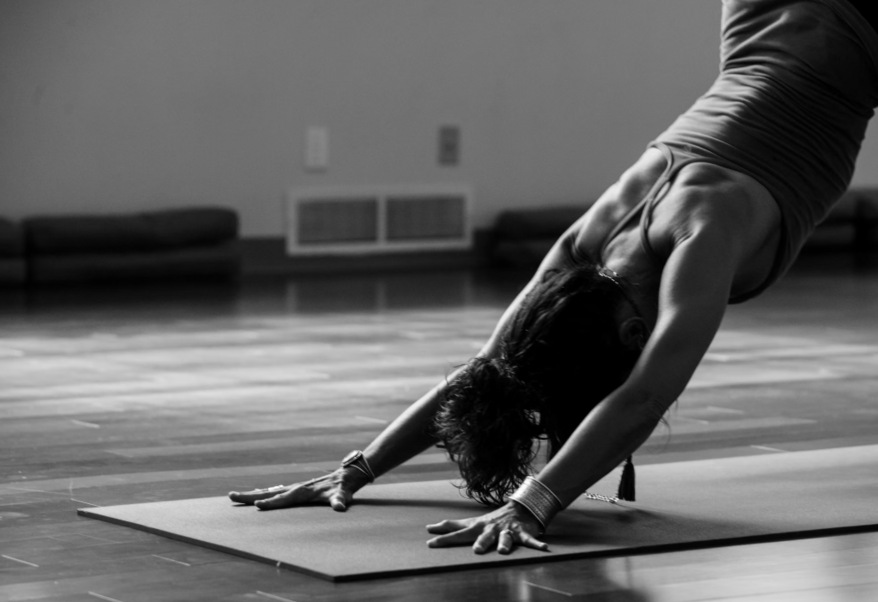
Plank exercises are often categorized as beginner poses and offer great benefits. For beginners, the yoga plank pose and its variations are strongly recommended for building endurance and core strength to support the practice of more advanced yoga postures. The plank pose also plays a central role in the Sun Salutation sequence (Surya Namaskar).
Initially, it might be difficult to hold the plank pose, but practicing it works wonders in developing both a physically strong and mentally resilient body. The basic plank exercise, along with its variations and breath-holding for a few minutes, also helps tone the nervous system.
Basic Plank Pose (Dandasana)
Dandasana is the foundational plank pose. The name comes from the Sanskrit word danda, meaning “stick” or “pillar,” and asana, meaning posture. It is also referred to as Kumbhakasana. The word kumbhak means breath retention.
Benefits
This pose tones all abdominal muscles, including the stomach, chest, and lower back. It strengthens the arms, wrists, and shoulders. It prepares the body for more challenging yoga poses. It strengthens and stretches the spinal muscles. It also improves posture.
How to do the Plank Pose
Lie down on your stomach. Place your hands beside your shoulders, keeping the palms on the floor. Inhale and lift your body into a straight line. Your arms should be perpendicular to the floor, with the shoulders aligned over the wrists, while the body remains parallel to the ground. Hold the pose and continue breathing. Exhale and return to a seated position and relax.
Contraindications
The plank pose should not be practiced if there is an injury in the hands, wrists, or legs, including the upper thighs. It should also be avoided in cases of high or low blood pressure, as the pose involves significant pressure on the chest while holding the position.
Types of Plank Exercises
You can perform a plank sequence, beginning with the basic pose and continuing with its variations. This provides a good muscle warm-up for your next yoga postures and offers benefits that will make you fall in love with yoga.
Upward Plank Pose (Poorvottanasana)
Poorvottanasana is associated with the flow of subtle energy (prana) through the eastern front of the body. "Poorva" means east, "uttana" means intense stretch, and "asana" means pose.
Side Plank Pose (Vasisthasana)
Vasistha is the name of one of the most revered sages, also one of the seven great seers (Saptarishis). "Vasistha" means wealthy, and "asana" means pose.
Dolphin Pose (Makara Adho Mukha Svanasana)
Makara Adho Mukha Svanasana is an intermediate-level rejuvenating yoga pose that tones the abdominal muscles. It is a variation of Dolphin Pose.
Yoga makes the body flexible and strong. It also calms the mind and lifts the spirit. Practicing these simple exercises and yoga poses will help strengthen your arms and prepare you for more advanced yoga practices.
Practicing yoga helps develop the body and mind, bringing numerous health benefits, but it is not a substitute for medical treatment. Yoga postures should be learned and practiced under the supervision of a trained Sri Sri Yoga teacher. In case of any medical condition, practice yoga only after consulting a doctor and a Sri Sri Yoga instructor.